
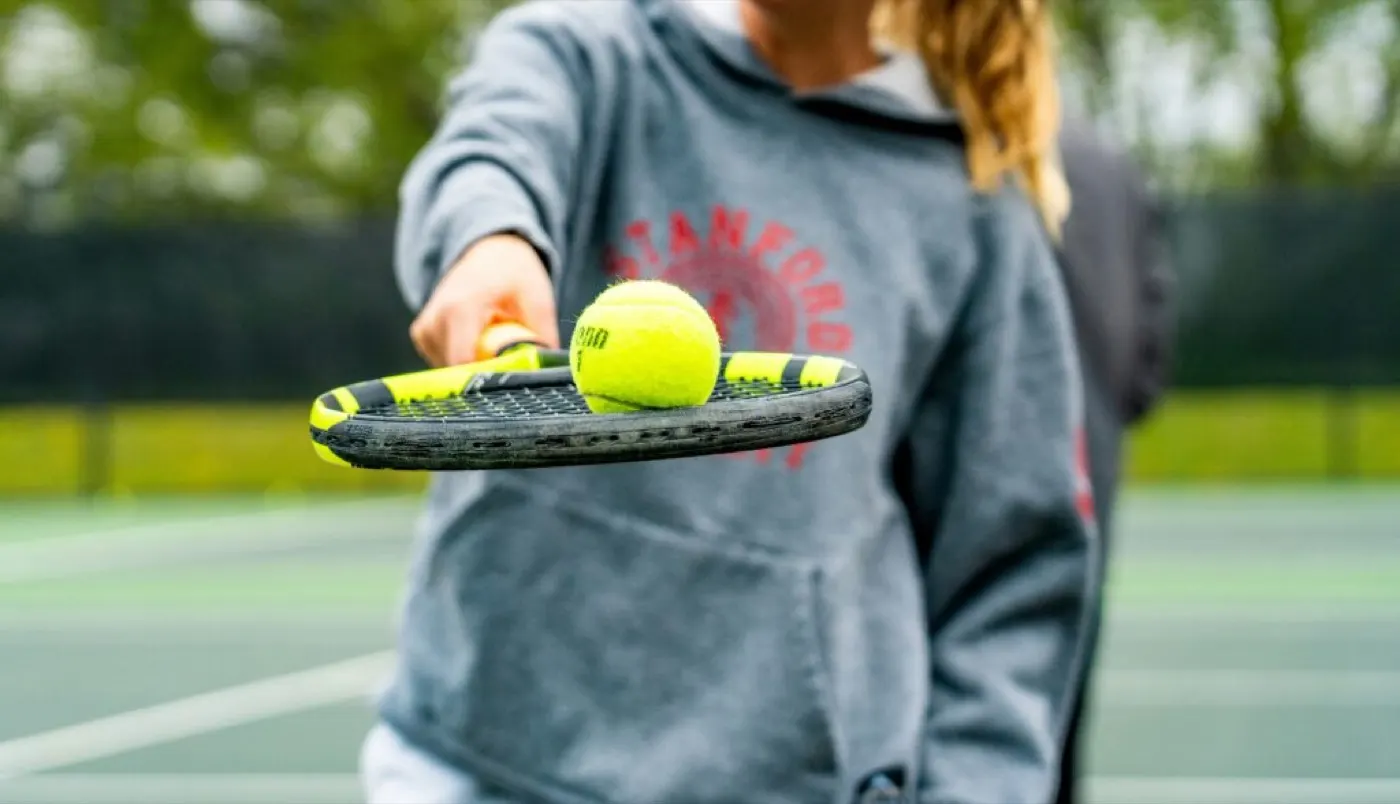
The condition often arises after repetitive loading over a longer period, but contrary to what the name suggests, you do not have to be a tennis player to develop the problem. In this article we look more closely at everything you need to know about tennis elbow.
What exactly is tennis elbow?
The condition is known in medical terminology as lateral epicondylalgia and is an overload of the common tendon of the extensor muscles in the forearm. This tendon lies on the outside of the elbow and attaches to the bony bump you can feel on the outside of the elbow. The condition is characterised by pain during activity, most often located at a specific point on the outside of the elbow that is also tender to touch. The pain can spread down the muscles of the forearm, and sometimes it can also ache for a while after activity. The condition arises from overload over time, often from repetitive loading. For example, the condition is more common among tradespeople who regularly use heavy tools and work in a one-sided and repetitive way with the wrist and arm. Because of the overload, we get a gradual breakdown of the tendon tissue, which then changes structure. The result is a tendon that no longer tolerates load as well as it used to.
How is the diagnosis made?
The diagnosis is mainly made clinically. That means a practitioner makes the diagnosis after a thorough examination and gathering of information. It is often an easy diagnosis to make based on the history of activity, the location of the pain, and the pain pattern. Occasionally, imaging such as an ultrasound examination can help confirm the diagnosis.
Typical features are a history suggesting overload, pain with activity but not at rest, pain on direct pressure over the tendon, and often somewhat reduced grip strength.
Tips and advice if you have tennis elbow:
- Adapt your everyday activity so that you do not provoke it unnecessarily. Manage this based on pain during and after activity. It is not dangerous to continue with painful activity, but it is hard to ignore the symptoms if you regularly provoke them.
- Give it time. This is a condition that often takes a long time to get rid of, and time also seems to be one of the most important factors in treatment. The vast majority are symptom-free after a year regardless of how it is treated.
- For pain relief you can try what is called isometric training. Hold a weight with the back of your hand facing up and support under your forearm. Work against your wrist dropping down and hold the position for 30-45 seconds, 3-5 rounds. You should experience a fairly immediate pain-relieving effect from round to round. It is also a good way to introduce a little load if you have had to take it very easy to avoid pain.
- Slow strength training with gradually increasing load has been shown to have a good effect on tendon tissue, so feel free to move on to more dynamic training of the forearm muscles when the pain allows it. Preferably heavy, and use pain after training to assess whether you have tolerated the session. Tendons usually tolerate slow movements better than fast ones, so start there.
- As you get the pain under control, you should gradually resume the activity you want to be doing. Other, less specific upper-body training is also good loading for the area and can be part of the treatment. You can continue with isometric training if you experience pain relief.
- Shockwave therapy can be an option for pain relief, but is not recommended as the first form of treatment and is usually tried after a longer period without improvement.
Summary
Tennis elbow can be a frustrating condition that takes a long time. It is, however, not a dangerous condition and often goes away on its own. Treatment is largely about making adjustments so that you can function as well as possible in everyday life. In addition, we want to find something that helps with the pain and lets you resume normal activity as quickly as possible. Our practitioners have good experience in diagnosing and treating tennis elbow, and can help you tailor a plan to get better as quickly as possible.
References:
- Kroslak M, Murrell GAC. Surgical Treatment of Lateral Epicondylitis: A Prospective, Randomized, Double-Blinded, Placebo-Controlled Clinical Trial. Am J Sports Med. 2018 Apr;46(5):1106-1113. doi: 10.1177/0363546517753385. Epub 2018 Mar 2. PMID: 29498885.
- Coombes BK, Bisset L, Brooks P, Khan A, Vicenzino B. Effect of corticosteroid injection, physiotherapy, or both on clinical outcomes in patients with unilateral lateral epicondylalgia: a randomized controlled trial. JAMA. 2013 Feb 6;309(5):461-9. doi: 10.1001/jama.2013.129. PMID: 23385272.
- Karanasios S, Korakakis V, Whiteley R, Vasilogeorgis I, Woodbridge S, Gioftsos G. Exercise interventions in lateral elbow tendinopathy have better outcomes than passive interventions, but the effects are small: a systematic review and meta-analysis of 2123 subjects in 30 trials. Br J Sports Med. 2021 May;55(9):477-485. doi: 10.1136/bjsports-2020-102525. Epub 2020 Nov 4. PMID: 33148599.
- Ikonen J, Lähdeoja T, Ardern CL, Buchbinder R, Reito A, Karjalainen T. Persistent Tennis Elbow Symptoms Have Little Prognostic Value: A Systematic Review and Meta-analysis. Clin Orthop Relat Res. 2022 Apr 1;480(4):647-660. doi: 10.1097/CORR.0000000000002058. PMID: 34874323; PMCID: PMC8923574.