
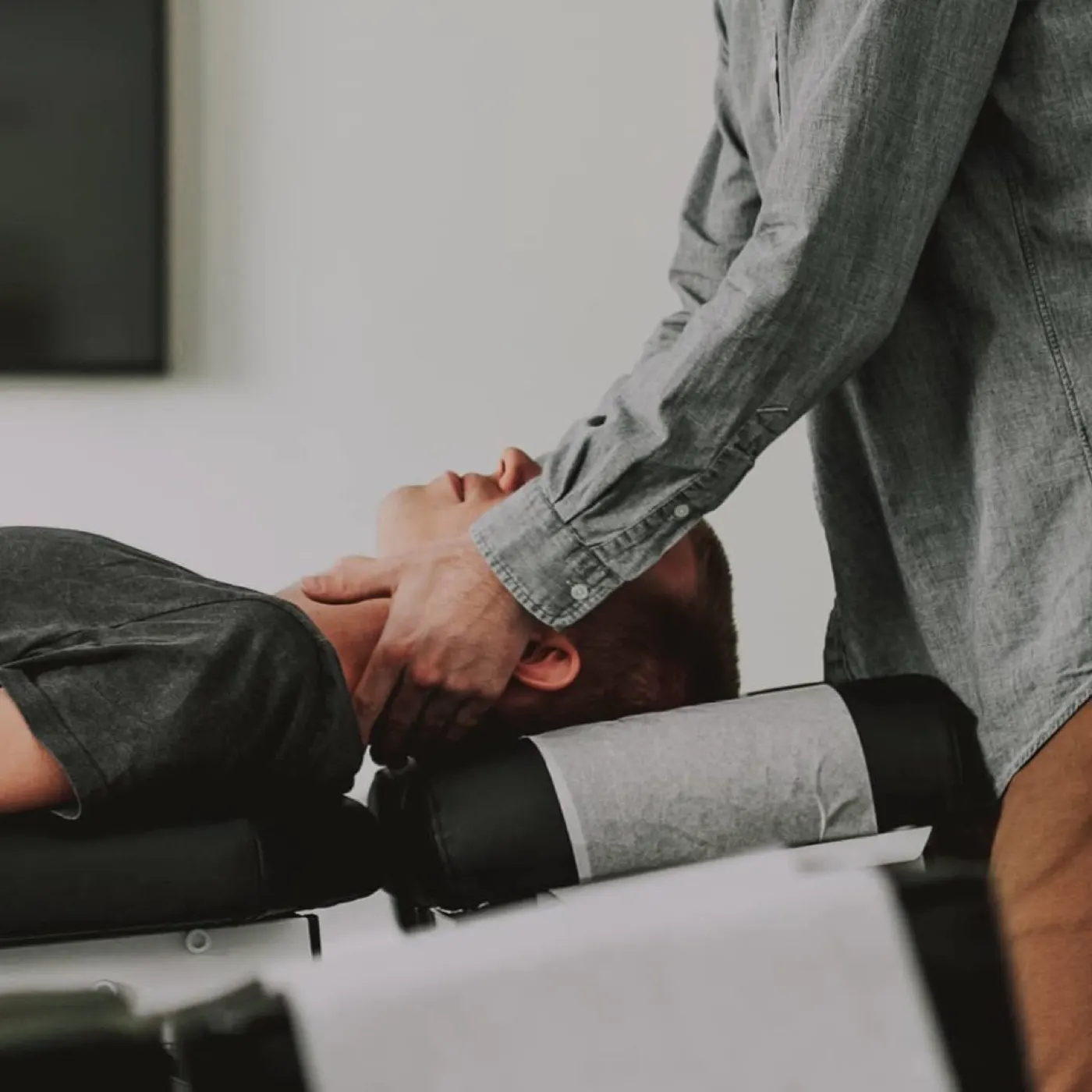
How is joint manipulation actually performed, and what is that “cracking sound”?
Manipulation treatment is performed with a quick and coordinated movement in the area around the joint in question. This causes a separation of the joint surfaces and creates negative pressure, and because of the vacuum that arises you will hear a “cracking sound”, also called cavitation. So no joints or discs are being moved or “put back in place”.
What does this type of treatment achieve?
Reduced mobility in a joint (often called “locking”) can cause nearby structures such as muscles, the joint capsule and the nervous system to be affected. This can cause pain, discomfort and stiffness. Joint manipulation is one of several tools used in the treatment of such problems. The purpose of manipulation is to provide pain relief, while also achieving better function and movement in the area where the treatment is applied. It is not known exactly why the treatment has a pain-relieving effect, but one of the most widely used explanations is that the nervous system's ability to reduce pain is improved.
It is important to note that this kind of treatment is only carried out after a thorough assessment and examination by authorised healthcare professionals. Chiropractors and manual therapists learn this treatment technique as part of their training.
There are no high-quality studies that conclude that manipulation is clearly better than other measures, but national guidelines for low back pain include manipulation as one of their suggestions for pain relief. Several practitioners at Behandlerverket use manipulation treatment daily and have good experience with it. However, it is seldom a treatment that stands alone, and it should be complemented. Other measures such as physical activity and exercises/training usually give faster improvement and a better effect in the long term.
Book an appointment with one of our skilled practitioners to get started with treatment and rehabilitation. We know what it takes for you to get better.
The post was written by: Physiotherapist/manual therapist Kristian Brynestad, chiropractor Eirik Bremnes and physiotherapist/manual therapist Arild Bolset.
Sources:
- Bialosky JE, Beneciuk JM, Bishop MD, Coronado RA, Penza CW, Simon CB, George SZ. Unraveling the Mechanisms of Manual Therapy: Modeling an Approach. J Orthop Sports Phys Ther. 2018 Jan;48(1):8-18. doi: 10.2519/jospt.2018.7476. Epub 2017 Oct 15. PMID: 29034802.
- Huijbregts PA. orthopaedic Manual Physical Therapy — History, Development and future opportunities. In Journal of Physical Therapy. 2010; 15
- Foster, N. E., Anema, J. R., Cherkin, D., Chou, R., Cohen, S. P., Gross, D. P., … Woolf, A. (2018). Prevention and treatment of low back pain: evidence, challenges, and promising directions. The Lancet, 391(10137), 2368–2383. doi:10.1016/s0140-6736(18)3048
- Brodal P 2013 Sentralnervesystemet 5. utgave Universitetsforlaget
- https://www.muskelskjeletthelse.no/wp-content/uploads/2016/06/Nasjonale-kliniske-retningslinjer-korsryggsmerter-2007-Fullversjon.pdf