
In today's instalment we start broadly. We are going to talk about how to prioritise, and what matters most when you put together a training plan to avoid injuries, especially load-related injuries. What actually matters most? Is it massage every other day, eating enough red meat, fasting, only training at threshold and never exceeding the limit? Or is the answer more nuanced than that?
Fortunately, it is both more nuanced and, at the same time, simple. The truth is probably that the small changes are not the ones you should spend too much energy, time or money on.
Load management
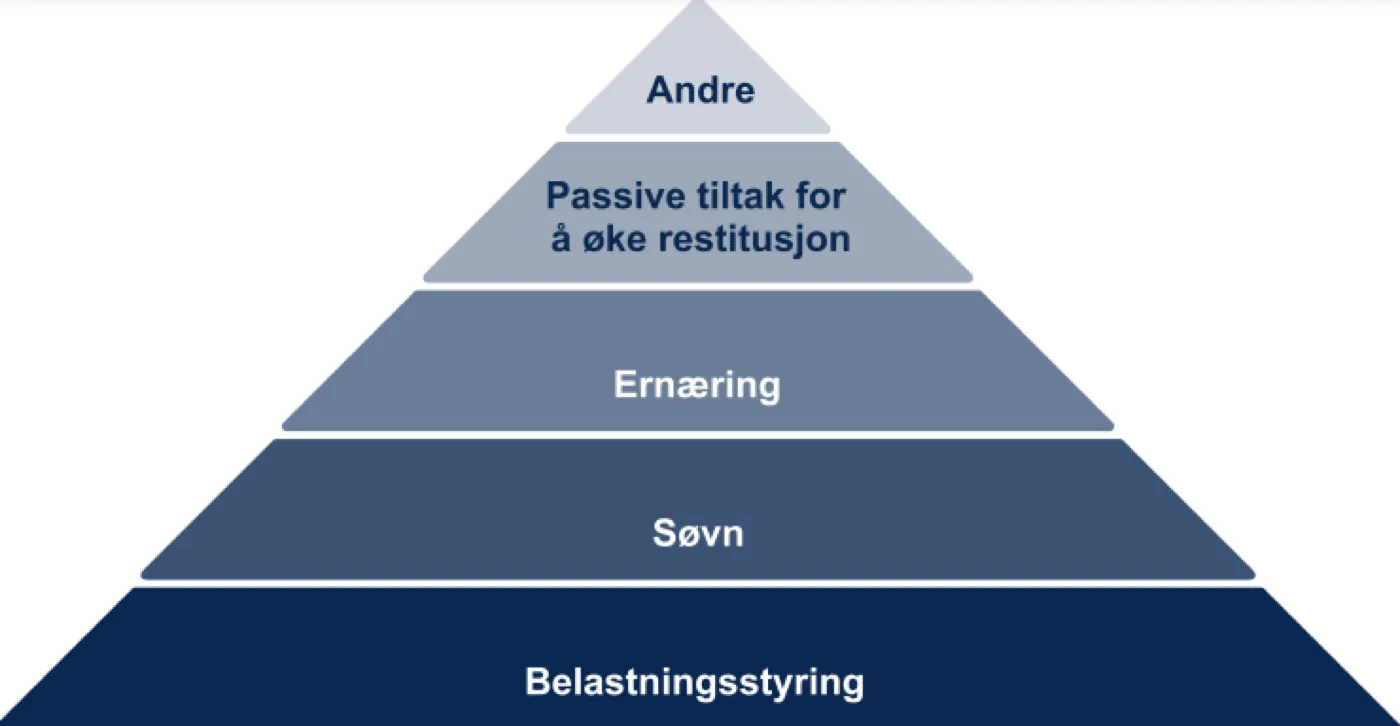
I like to use a pyramid to explain how to prioritise. At the base of this pyramid we find load management. Poor load management is the core cause of most of the overuse injuries we see in our clients. Increasing training volume too quickly, that is “too much, too fast, too soon, after too little, too long”, is unfortunately a common cause of injuries. It is rarely the case that a single training session, a session on tarmac or the wrong choice of shoes is the cause of an overuse injury. Overuse injuries develop over time, and may have started several months before the injury occurs. For someone who wants to avoid overload, it is therefore more important to think about the total training load than the load in an isolated training session.
Sleep
The next step in the pyramid is sleep, our best friend when it comes to recovery. Getting enough sleep is essential for anyone who trains a lot. Feel free to sleep a lot when you can, and take short “power naps” if the opportunity arises. Too little sleep increases the risk of illness in several ways, and a load-related injury is in fact only a minor concern compared with other potential health problems that result from a lack of sleep. We therefore strongly encourage prioritising sleep, not just for runners, but in general.
Nutrition
Step three in the pyramid is nutrition, a heated topic in today's society. My most important advice when it comes to nutrition is to avoid weight loss while you are training a lot. The combination of low energy intake and a large volume of training increases the risk of injury considerably. Maintaining a stable weight and eating enough food of good quality is important. I recommend using the Norwegian Institute of Public Health's plate model as a general starting point. If you feel that food and weight are difficult, or if you think that changing body composition could improve your performance, you should contact qualified personnel (for example a clinical nutritionist) who can help you with this assessment so that both health and performance are looked after.
Passive measures to increase recovery
Second from the top of the pyramid we find advice for those who do high-intensity training. If you are one of them, cold-water immersion can have a minimal effect on recovery. Next come measures that are more individual and are more about feeling than physiological effect. It is often the case that if you feel good, you recover better. Some runners prefer massage and will probably benefit from it for that reason. Others dislike it and may therefore experience a negative effect. Other measures that may feel pleasant but lack effect include active recovery, stretching, compression and massage.
Passive measures without documented effect
The top step of the pyramid shows the measures you often see in adverts or on social media. Everywhere you look, providers promote laser treatment, electrical stimulation, cryotherapy and/or floating. These measures have not been shown to have any particular effect, and they can also be expensive, so my recommendation is to be critical about which measures you choose to put both money and energy into.
Let's summarise
For the vast majority of us, it is important to optimise our everyday lives. It is the total load that increases the risk of injury. If you manage to get enough sleep, eat right and train sensibly, the probability is high that you will manage to stay injury-free and in shape. In periods when one of these factors changes significantly, it can be wise to adjust your training accordingly. I hope this was useful. In the next issue we will take up a specific injury, namely Achilles tendinopathy. This is better known as Achilles tendonitis, but you will be told why we choose to use the word tendinopathy instead.